
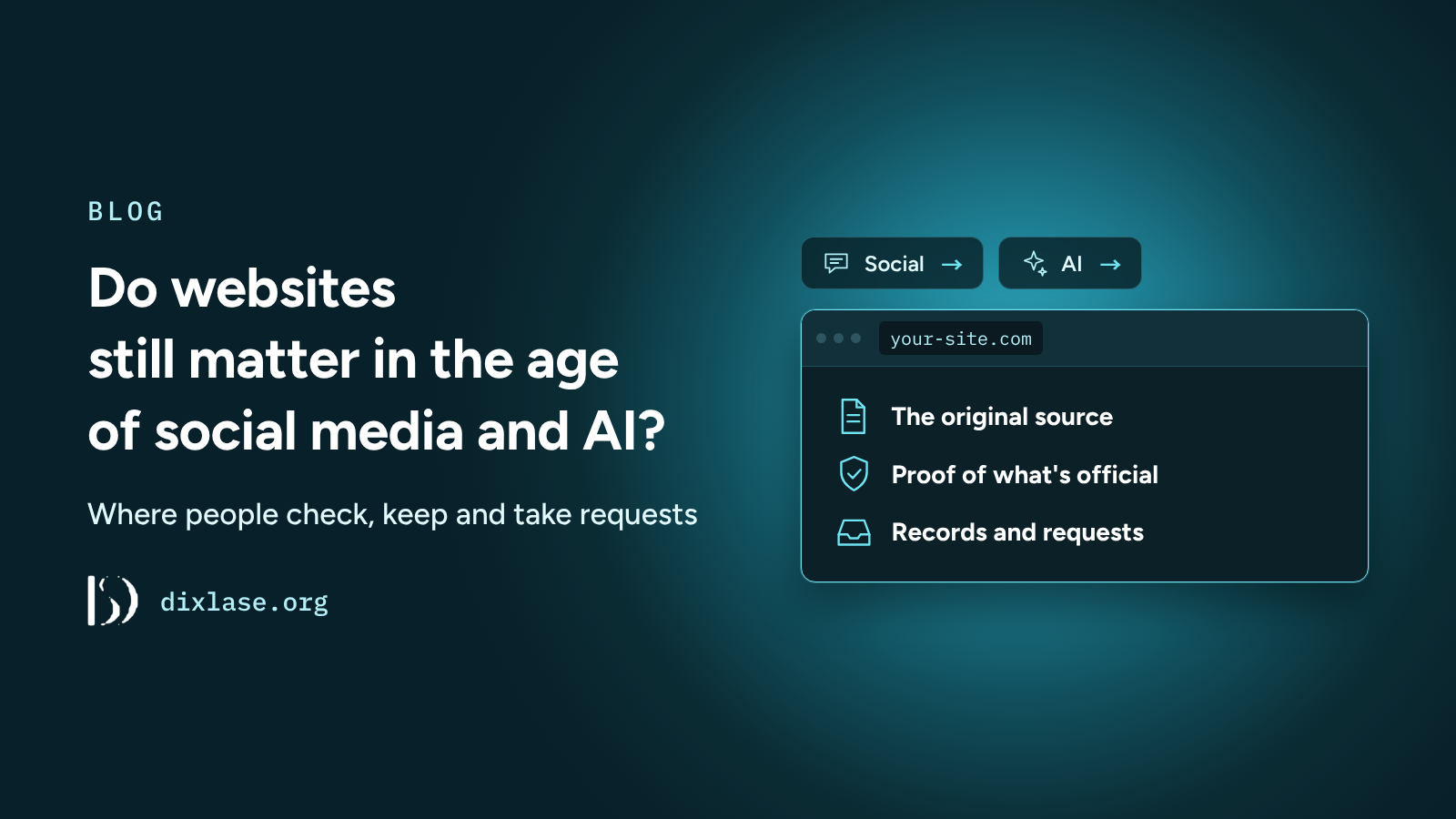
Do websites still matter in the age of social media and AI?
Hi, I'm Takeshi Kashihara (Kassy) from exc-D, the company developing Dixlase.
In this post, I'd like to take a fresh look at what websites are for.
Lately, we often see news of unauthorized access to websites and web services, and of data leaks.
In October 2026, a Japanese website builder disclosed unauthorized access, and said that data such as messages sent through forms on sites built with the service may have been exposed.
Source: Notice from the service provider (October 16, 2026, in Japanese)
In the same month, a serious vulnerability was found in PHP itself, and sites running on PHP had to update in a hurry.
Seeing all this, some people may feel that keeping a website running has become a burden.
Some may even wonder, "Why not just close the site and post on social media instead?"
Sources: The Hacker News / Amazon Threat Intelligence
Today, anyone can share information easily through social media and video.
And when we look something up, we no longer have to open search results one by one. We can just ask AI and get an answer.
Keeping a site safe takes more work than before, and there are more ways in to information than ever.
So do we still need websites?
Since we build a CMS, you can probably guess my answer.
Here, I'd like to explain why, sticking to the facts as much as I can.
The way in to information has moved to social media and AI
First, how we get information has clearly changed a lot over the past ten years or so.
According to Japan's 2025 White Paper on Information and Communications, the share of people who mainly read text news through news feeds on portal sites, social media and similar services rose from 36.8% in 2014 to 73.0% in 2024.
About 30% of people in every age group also use YouTube to follow the news.
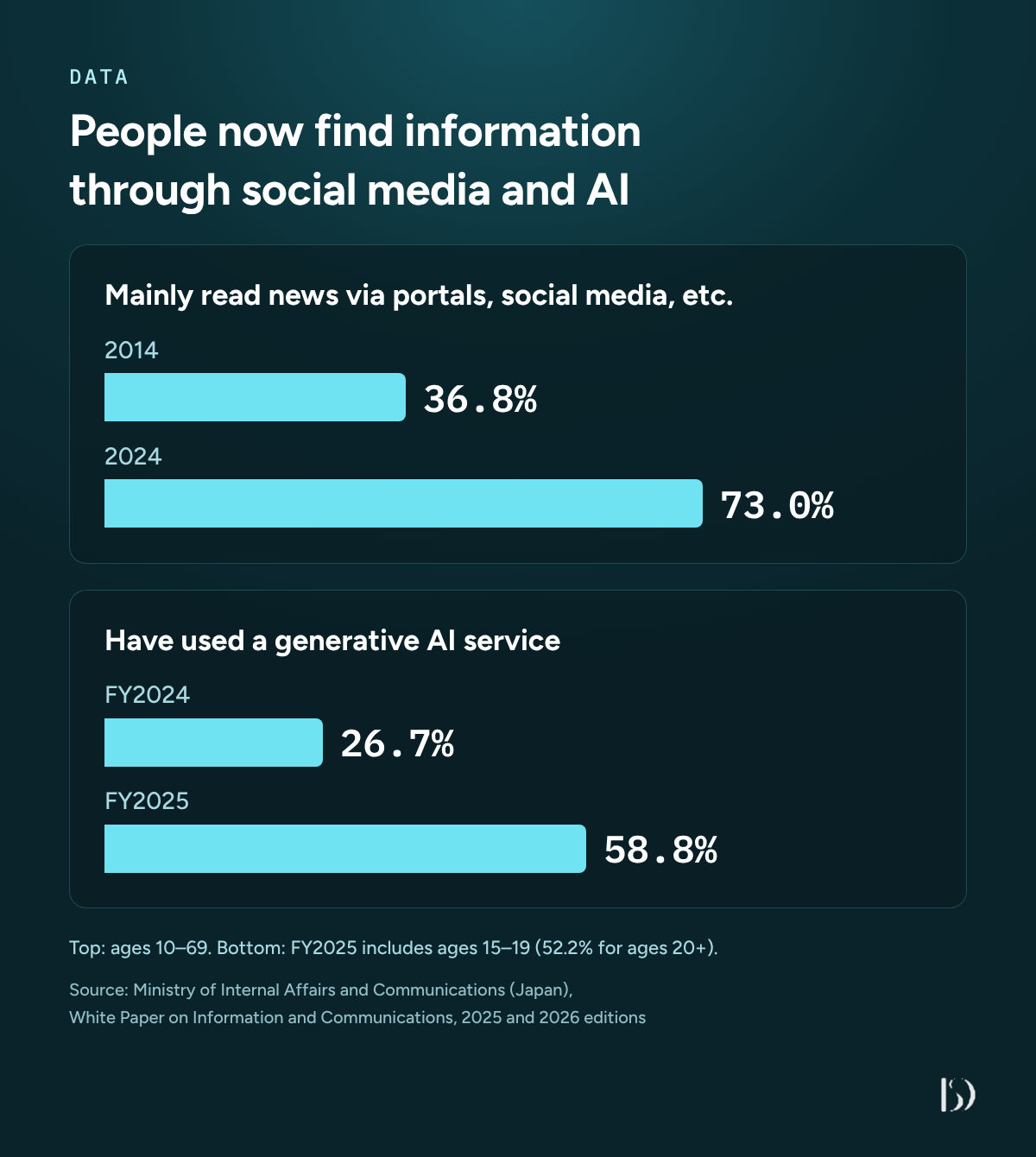
AI use has also jumped.
The 2026 White Paper reports that the share of people who have used a generative AI service rose from 26.7% in fiscal 2024 to 58.8% in fiscal 2025.
There's no doubt that people now find information in many ways, not only through search engines but also through social media and AI.
So have websites lost their purpose? We think their role has actually become clearer.
AI answers need a source, too
AI doesn't make up answers out of nothing.
AI services that work with search build their answers from information on the web, and some show links to the sites they drew on.
In October 2026, Google announced that it would show links to source websites more prominently in its AI search answers.
It has also been reported to be testing a view in AI Mode that groups official websites at the top of an answer.
Source: Business Today (October 16, 2026)
If there's no place where you describe yourself accurately, in your own words, AI will talk about you based on someone else's summary or outdated information, without knowing whether it's right.
To help AI get you right, you need a place for your primary information.
A place to check what's real
Social media makes posting easy, but it also makes impersonation easy.
In August 2026, Japan's Digital Agency, together with the National Police Agency, the Consumer Affairs Agency and others, asked major social media and advertising companies to act against scam ads that impersonate real people and brands.
According to the Council of Anti-Phishing Japan's Phishing Report 2026, phishing reports in 2025 reached about 2.45 million, the highest ever. The names of 229 brands were misused.
Sources: Digital Agency (August 7, 2026, in Japanese) / ScanNetSecurity, "Phishing Report 2026" (June 11, 2026, in Japanese)
In this situation, a website on your own domain can show people, "This is the official one."
If you list your official social media accounts, contact details and announcements on your official site, anyone who's unsure can come and check.
That said, fake sites now use their own domains too.
The same report says that as of December 2025, about 75% of phishing reports came from domains set up by the attackers themselves.
Having an official site isn't enough on its own. It's important to share your correct domain regularly, on business cards, in social media profiles and elsewhere.
Yours to keep
Social media posts drift away over time.
When a platform changes how it shows posts or updates its terms, your reach changes too, and the service itself may even shut down.
This isn't any one service's fault. It comes with writing in a space that belongs to someone else.
I wrote more about this in the first post on this blog.
The things you want people to come back to, and the things you want to keep as they are, can live in a place of your own.
Open to anyone, no account needed
Some social media services won't let you read further unless you log in, and some are hard to read without their app.
A website can be read by anyone with a browser.
It reaches people who don't use social media and people looking things up on a work computer just the same.
A place to accept requests and get things done
Inquiries, applications, bookings, members-only pages.
Accepting requests and handling procedures like these is hard to do on social media.
Taking in information yourself, and handling it responsibly yourself.
A website is essential as a place for that, too.
I'll write about the systems that keep such sites running in my next post, on whether we still need a CMS.
Looking ahead: a way in for AI to read and use
Going forward, we expect to see more cases where AI reads websites on people's behalf, and even completes procedures for them.
When that happens, having well-organized primary information that AI can read correctly should matter even more.
This is still an outlook, but we believe the role of websites will grow, not disappear.
Wrapping up
Social media, video and AI are very handy tools. We use them, and we'll keep using them.
But each is good at different things.
Social media is a place to announce.
AI is a tool that finds and sums things up.
A website is a place to check, keep and accept.
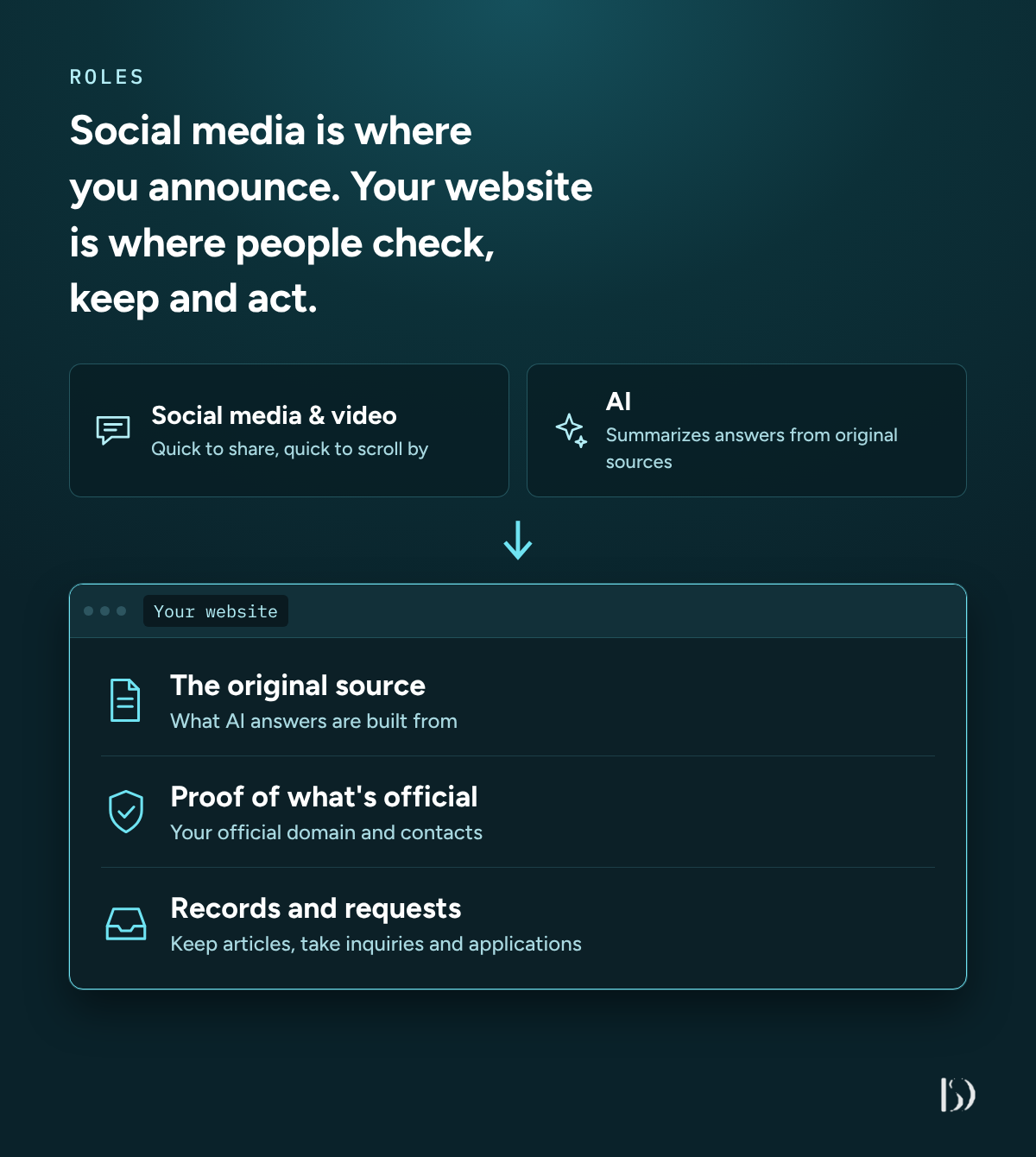
And the answers AI puts together are built on the primary information placed on websites.
We think using these three together is the way to share information that fits the times.
Dixlase aims to be a CMS for running that place to check, keep and accept, safely.
Of course, having a site also means work, like the updates the PHP issue called for.
Close the site and use only social media, and that work goes away. But you'd also be giving up the place to check, keep and accept that I described here.
And how much work it takes depends a lot on how the site is built and run.
In my next post, I'll look at whether we still need a CMS, the system that runs a website, including that work.
We'd love to hear your thoughts. Feel free to share them through GitHub Issues or on social media.